Monday, July 27, 2009

A Week-End Warp Weighted Loom Project

The plaid yardage is not the first project on this loom. She made her debut at the Griffin Dyeworks Fiber Retreat in 2008, with a group project to weave a shawl in a weekend. We had from noon on Friday until noon on Sunday to weave the header band, tie the heddles, weave and finish off the shawl. For every 15 minutes a participant worked on the project, she or he got a raffle ticket. At the end of the retreat we raffled off the shawl.

Many hands made it possible to finish – although we did have to weave into the night on Saturday to stay on track. Many of the participants had no previous weaving experience, and it was exciting to watch them experience the magic of weaving cloth for the first time.

Here’s a picture of Mel weaving the header band using an inkle loom and warping board, clamped side by side to a table:


And here’s tyeing the heddles:


With a step stool, this became a multigenerational project:

Bridget wields the sword beater:


The warp was black wool from Halcyon Yarn. The weft was space dyed with many flavors of Kool-Aid
for a result that could only be called “tooty fruity”! The multi-color yarn could have been alarming, but the black warp toned it down and made a truly dramatic shawl. Here’s a close up:


And here’s Ercil modeling the finished shawl:

Wednesday, July 8, 2009

Elephant Anatomy

My current project started life on another loom, borrowed from my friend Ellen. You can see pictures of the loom (and of the beginning of this project) at her Warp Weighted Loom blog. After a while, I started feeling guilty about having her loom for so long, so I decided I needed a warp weighted loom of my own.

It looked to me that Ellen’s design would be fairly simple to construct with a power saw and a drill press. Unfortunately, I don’t do hardware, only software, and the only power tools I possess are sewing machines. So I asked my friends Sean and Mary Ann to help me build a loom.

The first thing you need to know about Sean and Mary Ann is that everything they do, they do very, very well. It’s a combination of talent, intelligence and careful planning. The other thing you need to know is that they never do anything half-way. Sean and Mary Ann came over to take a few measurements off of Ellen’s loom while it was set up in my kitchen, and discuss any modifications I wanted. It quickly became clear that I wasn’t going to get a loom made of cheap pine from Home Depot. Also that more equipment than a chop saw and drill press would be needed.

Sean picked out some beautiful ash wood from the lumber yard. We spent a weekend in their shop using power tools I didn’t even know existed. Sean and Mary Ann were kind enough to let me pretend that I was helping – not just getting in the way. By the end of the weekend I had a beautiful loom made to my personal specifications made out of ash wood, with mortise and tenon joints.

A traditional warp weighted loom leans against a wall. I needed a loom that was free standing – I don’t have any empty wall space that isn’t a sliding glass door. I also needed a loom that could be disassembled and transported so I could use it for classes and demos. So my loom has a back upright that is hinged to the front. There are two cross pieces in the back and one in the front, that peg to the uprights and stabilize width of the loom. The cross pieces on each side hold it open. The loom breaks down into (mostly) flat pieces and a few pegs that I can easily transport in my minivan.


The top (cloth) beam must be braked in some way to keep it from unrolling under the weight of the warp. We decided to do this by shaping the beam into an octagon that fits snuggly into the supports.


I’m particularly proud of the heddle rod supports. They are based on an archaeological find from Trondheim, Sweden, circa 1120 – 1200 a.d. The original is pictured on page 232 of “Tidens Tand Nr. 5”, the report of the 4th NESAT Symposium. I enlarged the photo to the size needed and transferred it to the wood (Sean cut it out on the scroll saw).


So that’s the basic anatomy of my elephant. If you want of an elephant of your own there are instructions here at the House Barra web site and here at Barbara atte Dragon's web site.

Monday, June 29, 2009

The Elephant in the Room

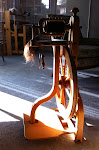
There’s an elephant in my living room. You know what I mean, something large and obvious that you do your best to ignore. My elephant is a warp weighted loom. It stands in the opening between my living room and my loom room. It has been standing there for a very long time.


The fabric on the loom is a plaid wool that was started as a class project. Perhaps foolishly, I decided that I wanted to put on a warp long enough to have a useful piece of fabric when I was done – 5 yards to be exact.

As a learning experience it was very successful for me (even though I was one of the teachers for the class!) – I learned that it is possible to pack the warp into the tablet woven header band way too tightly. So instead of the recommended sett or 20 – 28 ends per inch for plain weave, I have a sett of 36 – 40 ends per inch. This means a couple things. First, the fabric is warp faced, very warp faced. Second, it’s a bit of a struggle to get a clear shed. Third, the warps sticking together causes abrasion and breakage.

Now it takes a while to weave on a warp weighted loom – longer than on a floor loom (there is a reason they invented those treadles). When it’s hard to get a clear shed it takes even longer. And you’re standing up the whole time. So, are you surprised that my loom is an elephant?

I’ve made a promise to myself. I will finish this project by the end of the summer and nothing goes on the floor loom until the WWL comes down. Stay tuned to this channel for updates.